

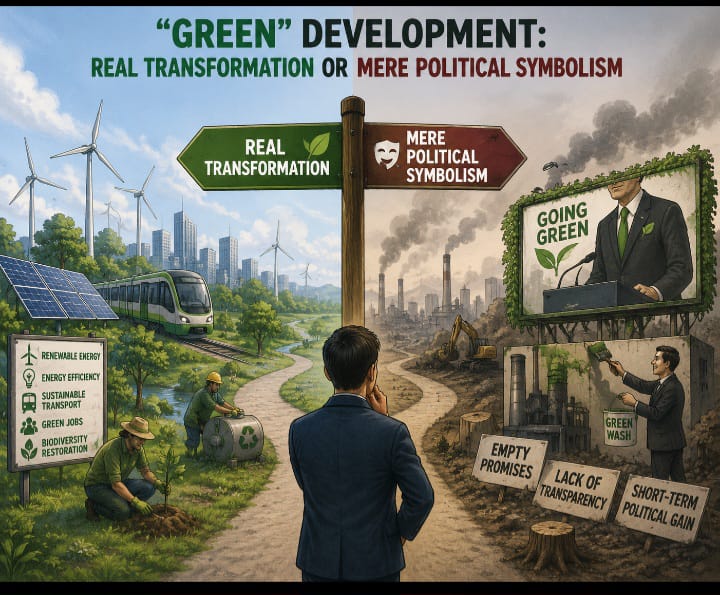
PERSPEKTIFNUSANTARA.COM– The world is facing serious environmental challenges, including climate change, pollution, deforestation, and the depletion of natural resources. In response, governments and organizations have increasingly promoted green development, a concept that combines economic growth with environmental protection and social well-being. While many consider it an important solution for achieving sustainability, others question whether it represents real progress or merely serves as a political symbol.
Supporters of green development argue that it is essential for creating a sustainable future. Traditional development often focuses on economic growth without considering environmental impacts, resulting in ecosystem damage and increased environmental problems. Green development seeks to address these issues by encouraging renewable energy, sustainable agriculture, environmentally friendly technologies, and responsible resource management. Through these efforts, economic development can continue while reducing harm to the environment.
One of the most significant benefits of green development is its role in combating climate change. Many countries have introduced policies that support clean energy, energy efficiency, and low-carbon transportation systems. These initiatives help reduce greenhouse gas emissions and promote more sustainable economic growth. As a result, green development is often viewed as a practical response to global environmental challenges.
Baca juga: Schools Today: Chasing Grades, Neglecting Skills
However, critics argue that green development is sometimes used more as a political tool than a genuine commitment to sustainability. Governments and corporations may promote environmental programs to improve their public image, attract investment, or gain political support. In some cases, projects labeled as “green” continue to contribute to pollution, habitat destruction, or social inequality. This raises concerns about whether sustainability goals are truly being achieved.
Another issue is greenwashing, a practice in which organizations present themselves as environmentally responsible without making meaningful changes. Companies may advertise their commitment to sustainability while continuing harmful activities, and governments may announce ambitious environmental targets without providing sufficient resources to achieve them. Such actions create the appearance of progress while maintaining existing practices, leading to public distrust.
Despite these concerns, it would be unfair to conclude that all green development initiatives are merely symbolic. Around the world, many projects have produced measurable environmental and social benefits. Investments in renewable energy have reduced dependence on fossil fuels, conservation programs have protected natural habitats, and sustainable urban planning has improved living conditions in many communities. These examples demonstrate that green development can be effective when supported by strong policies, adequate funding, and accountable implementation.
Baca juga: When Fear Replaces Curiosity in the Classroom
Public participation is also essential in ensuring the success of green development. Citizens, researchers, environmental organizations, and the media play an important role in monitoring policies, exposing greenwashing, and demanding transparency. Their involvement helps ensure that sustainability efforts produce real and measurable outcomes.